Why Most Filipinos Stay Poor Even While Working Hard
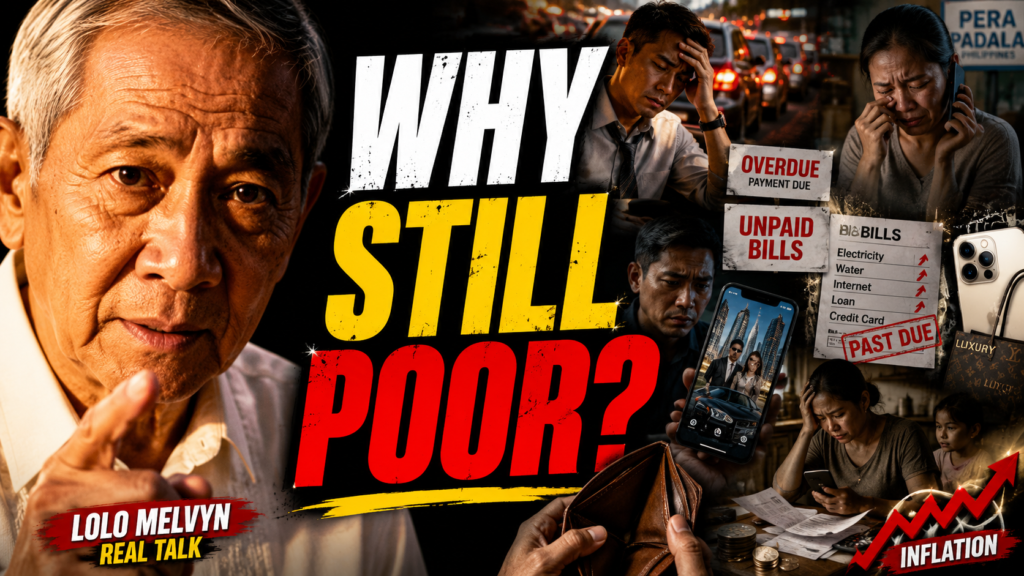
You know what’s heartbreaking? Some Filipinos wake up at 4 AM, fight horrific traffic for hours, work exhausting jobs, sacrifice precious time with their family, send money to relatives, work abroad for years, and still remain completely financially trapped.
That’s deeply painful.
Many of these people are not lazy. They are incredibly hardworking. Responsible. Sacrificial. Strong. And yet, after decades of hard work, many still end up drowning in debt, living paycheck to paycheck, financially dependent on others, emotionally exhausted, afraid of emergencies, and unable to retire peacefully.
The painful question becomes: “How can someone work this hard and still struggle this much?”
Now listen carefully. This is not about insulting anyone. This is not about arrogance. This is about absolute truth. If we do not understand the real root problem, the cycle will continue for another generation.
Today, Lolo Melvyn will tell you something many people are too afraid to say to your face: Hard work alone is not enough. And that is the true tragedy.
1. Many Filipinos Were Taught How to Survive… But Not How to Build Wealth
From childhood, what were many of us taught? “Mag-aral ka mabuti.” “Humanap ka ng stable na trabaho.” “Magtrabaho ka nang mabuti.” “Tiisin mo lang.”
So our people became world-class experts at survival. But they never became experts at financial growth. Nobody taught us how to invest, how to budget, what assets are, the power of compounding, business systems, wealth building, or financial psychology.
People learn how to earn money, but they never learn how to multiply it. Slowly, their entire life becomes one endless cycle: work, pay bills, repeat. Work, pay utang, repeat. Work, survive, repeat.
One day they wake up and realize, “I’ve been working for decades, but I’m still financially fragile.” Survival without strategy becomes lifelong exhaustion.
2. Filipino “Utang” Culture is Destroying Many Families
Now this topic is sensitive, but we need to speak the truth. Many Filipinos normalize bad debt far too much. Utang for new gadgets, utang for grand celebrations, utang for appearances, and utang to maintain a consumer lifestyle just to impress other people.
Slowly, debt becomes a permanent resident in the household.
Listen carefully: Debt is incredibly dangerous when it becomes emotional. Some people borrow money not out of necessity, but because of intense societal pressure—pressure to look successful, pressure to keep up, and pressure to avoid shame. They buy things they cannot afford to impress people who are also quietly struggling.
Social media made this epidemic worse. People now feel poor not because they lack their basic needs, but because they compare themselves constantly. Comparison creates artificial poverty. Suddenly, your phone feels outdated, your life feels behind, your income feels small, and your home feels embarrassing. Why? Because you were trained to measure your worth through appearance.
3. Many Filipinos Are Emotionally Spending
This one runs deep. Some people are not broke because they lack income; they are broke because they spend entirely based on their feelings.
“Deserve ko ‘to.” After stress, they go shopping. After heartbreak, they go shopping. After payday, they go shopping. After feeling insecure, they go shopping. Slowly, temporary emotional relief becomes permanent financial pain.
Money problems are often emotional problems wearing financial clothes. Some people spend because they grew up deprived, they want validation, they crave acceptance, or they are trying to heal deep internal pain through consumption.
But healing cannot be purchased at a mall. No gadget can heal insecurity. No luxury can heal emptiness. No branded item can repair a broken identity. Only wisdom and healing can do that.
4. Many People Have a Worker Mindset… But Not an Owner Mindset
This distinction is critical. A worker asks, “How much will I earn this month?” An owner asks, “How do I build something that grows beyond my physical time?” That is a massive operational difference.
Many Filipinos only think about active income—meaning if they stop physically working, the money stops too. That creates permanent, unrelenting pressure on your shoulders.
There is absolute dignity in honest, hard work. But if your entire financial system depends solely on your physical labor forever, exhaustion will eventually catch up with you. That’s why you must eventually learn high-value skills, investing, systems, business thinking, and multiple income streams. One income source in today’s world is dangerous, especially when inflation keeps rising.
5. Many Filipinos Are Afraid to Learn New Skills
This one hurts. Some people completely stop growing the day they graduate. No new learning, no upgrading, no self-improvement. They maintain the exact same mindset for 20 years and then wonder why their life stays exactly the same.
Listen carefully: The modern economy rewards adaptability. Technology is changing everything. AI is changing everything. Business, marketing, and communication are changing daily.
People who refuse to learn will slowly become economically vulnerable. Growth is uncomfortable, but poverty is also uncomfortable. You must choose your hard.
6. Many Filipinos Are Surrounded by Broke Thinking
Your environment matters immensely. If everybody around you normalizes debt, hates discipline, laughs at ambition, discourages growth, and fears change, you will slowly absorb that exact mentality. Humans naturally adapt to their surroundings.
Broke thinking sounds like this:
- “Okay na ‘yan.”
- “Minsan lang naman.”
- “Bahala na.”
- “Hindi mo naman madadala sa hukay ‘yan.”
- “Masama maging masyadong ambitious.”
No, Apo. That mindset destroys futures. Wealth is not built through random emotions; it is built through intentional, strategic decisions repeated for years. Your daily habits become your financial destiny.
7. Many Filipinos Prioritize Image Over Peace
This is becoming a national epidemic. People now want to look rich more than they actually want to be rich. They want the luxury lifestyle photos, the travel check-ins, the coffee shop culture, and the expensive phones to flex online.
But what is happening behind the scenes? Massive stress, mounting debt, chronic anxiety, and financial panic.
The saddest part is that many people are financially drowning quietly while performing happiness publicly. Real wealth is often quiet. Real peace rarely needs external validation. Real stability looks incredibly boring sometimes. Stop sacrificing your generational future for temporary internet attention.
8. Many Filipinos Never Heal Their Trauma
Some financial struggles are rooted deeply in emotional wounds. People who grew up severely poor sometimes develop a toxic scarcity mindset, an intense fear of losing money, a fear of success, patterns of self-sabotage, or impulsive spending habits.
Trauma directly dictates financial behavior. A wounded mind will always make wounded decisions.
This is why emotional healing matters. If your inner life is broken, money alone will not save you. You can increase your income, but you will still destroy your future through emotional instability. Some people need financial literacy, but many also need deep emotional healing first.
9. Many People Wait for Miracles… But Refuse Discipline
Listen closely: Prayer matters. Faith matters. God matters. But your discipline matters too.
Some people constantly pray for a financial breakthrough while continuing their destructive, unmanaged habits. No budgeting, no saving, no learning, no planning, and no personal growth. And then they wonder why their prayers feel unanswered.
Faith without responsibility becomes passivity. God gives you wisdom, but you must apply it. God gives you strategic opportunities, but you must move your feet. Miracles do not replace personal discipline.
10. Many Filipinos Think Short-Term
This is one of our biggest hidden traps. People focus only on today’s cravings, today’s emotions, and today’s comfort. But wealth requires long-term horizon thinking.
Every single peso is a seed, and every seed you waste today cannot grow into a tree tomorrow. Wealth is slow. Discipline is slow. Transformation is slow.
But remember this: destruction is also very slow. That’s why many people don’t notice the danger immediately. Bad habits look completely harmless at first—until years pass, and suddenly, life becomes brutally heavy.
Your Tactical Blueprint: What to Do Now
Start simple. Very simple:
- Learn financial literacy daily.
- Track every single expense.
- Avoid unnecessary consumer debt.
- Stop spending based on temporary emotions.
- Build multiple income streams.
- Learn high-value, modern skills.
- Read books and invest in your mind.
- Protect your inner peace at all costs.
- Choose your environment with extreme caution.
- Think long-term for your lineage.
Stop believing the lie that hard work alone automatically creates wealth. Without wisdom, hard work simply becomes lifelong survival instead of real transformation.
Final Real Talk
Most Filipinos are not poor because they are lazy. Many are poor because they were never taught financial wisdom, they inherited a survival mentality, they normalized bad debt, they spend emotionally, they lack long-term thinking, they are trapped in destructive environments, and they confuse image with actual success. That cycle silently repeats across generations.
But cycles can be broken, Apo. A different future is entirely possible.
It happens one disciplined decision at a time. One wiser habit at a time. One healed mindset at a time. One financially intelligent choice at a time. You do not need to become rich overnight, but you must stop living unconsciously.
Poverty is not always about a lack of money. Sometimes, it is the cumulative result of unhealed pain, undisciplined habits, financial ignorance, and poor daily decisions repeated for years.
This is Lolo Melvyn Real Talk. Sometimes, the truth people avoid the most is the exact same truth that can finally set their future free.
Let’s get to work.
Pingback: The Biggest Regret People Have at Age 70 | Lolo Melvyn
Pingback: The Most Expensive Security Mistakes Billionaires Make
Pingback: The Most Expensive Executive Protection Details in the World
Pingback: The Most Expensive Mistakes Young Leaders Make in Their 20s
Pingback: The Great Forgetting | Lolo Melvyn Real Talk
Pingback: The Prison You Cannot See | Lolo Melvyn Real Talk
Pingback: The Price of Silent Strength | Lolo Melvyn Real Talk
Pingback: One Distraction at a Time | Lolo Melvyn Real Talk