Helping Or Spoiling? The OFW Guide to Healthy Family Boundaries
By Lolo Melvyn | Published in OFW Real Talk
Helping Or Spoiling? Distinguish true financial empowerment from permanent dependence to build a self-sufficient family.
📌 Official Freedom Resources & Quick Links:
- 📖 Get the Book on Amazon: Until We Meet Again on Amazon
- 🎁 Download FREE Ebook: Claim The OFW Freedom Starter Kit
- 🌐 Explore Official Guides: Official Website | Lolo Melvyn Bookshop | Your Salary Needs A Mission | Don’t Fly Home Unprepared | Don’t Sacrifice Your Children’s Future | What Is Your Freedom Number | Where Does Your Remittance Go | How To Say No Without Guilt | You Are Not An ATM Guide | Starter Kit Explainer | Someday Is Not A Plan | Working Abroad Without a Finish Line
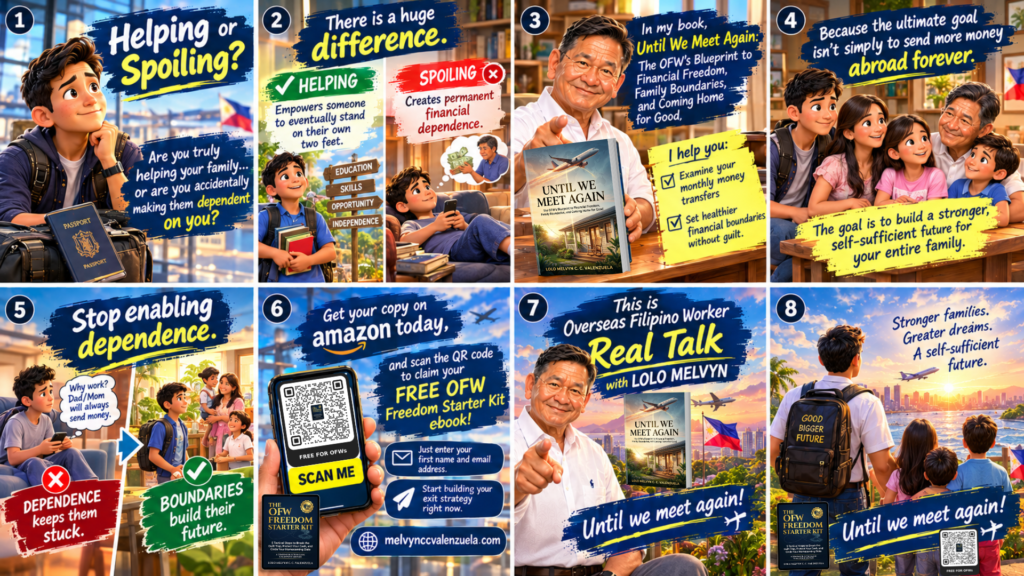
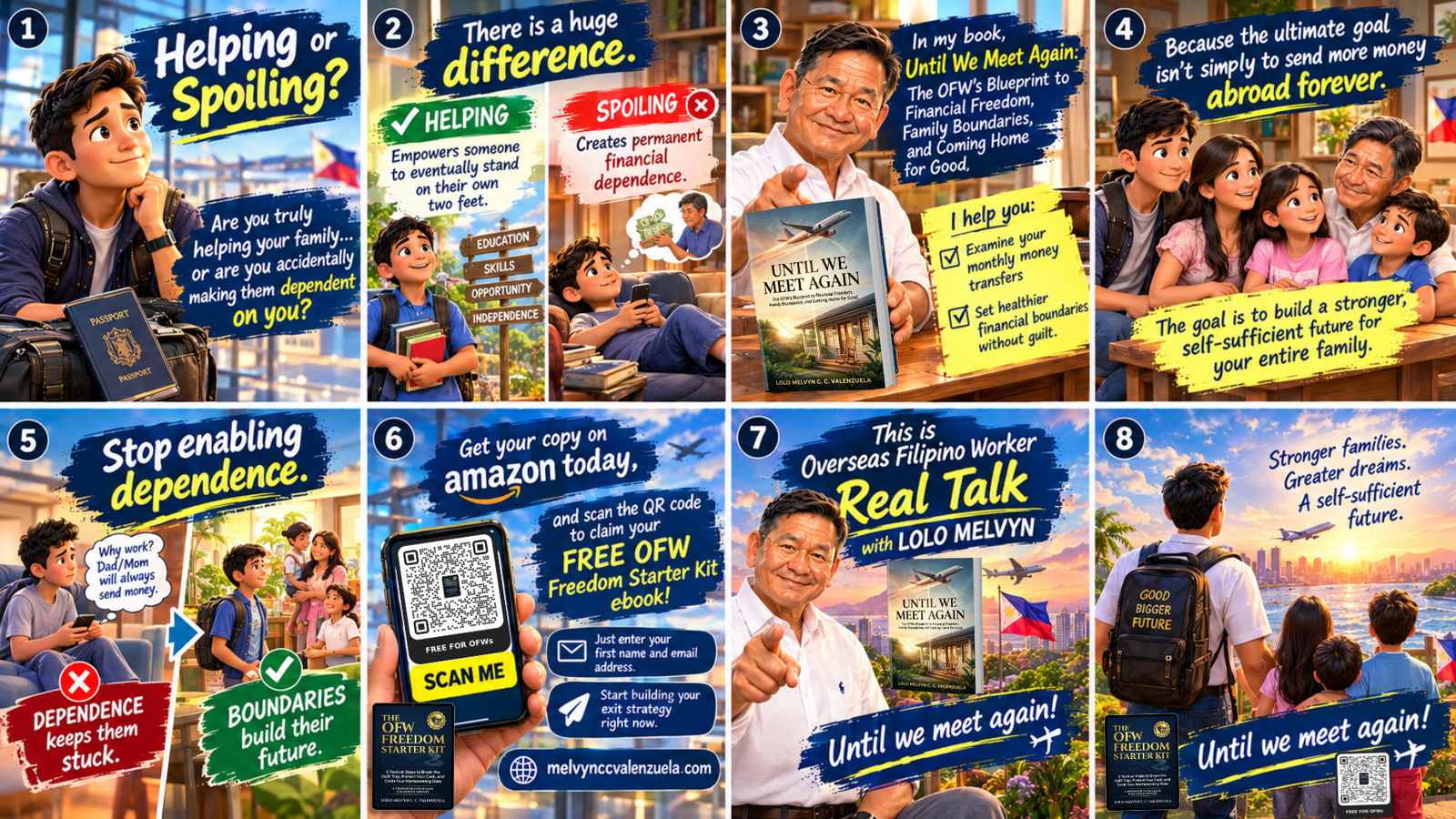
Are you truly helping your family… or are you accidentally making them dependent on you? This is a fundamental question every Overseas Filipino Worker must face honestly: Helping Or Spoiling?
There is a huge difference between these two approaches. Helping empowers someone to eventually stand on their own two feet and build local independence. Spoiling, on the other hand, creates permanent financial dependence, leaving you trapped in an endless cycle of foreign labor to support unmanaged household habits back home.
In his book, Until We Meet Again: The OFW’s Blueprint to Financial Freedom, Family Boundaries, and Coming Home for Good, Lolo Melvyn helps you examine your monthly money transfers and set healthier financial boundaries without carrying guilt on your shoulders.
Because the ultimate goal isn’t simply to send more money abroad forever. The goal is to build a stronger, self-sufficient future for your entire family. Understanding the line between Helping Or Spoiling is the key to breaking free from endless contracts and securing a lasting homecoming.
📺 Watch Lolo Melvyn’s Real Talk Video:
Table of Contents
- Helping Or Spoiling: Understanding the Critical Difference
- Signs You Are Spoiling Instead of Helping Your Household
- How Helping Or Spoiling Rules Align with the Inner Circle
- Setting Financial Boundaries: Transitioning to True Empowerment
- Structuring Remittances to Promote Family Self-Sufficiency
- Executing Your Strategy with the OFW Freedom Starter Kit
- Conclusion: Stop Enabling Dependence Today
Helping Or Spoiling: Understanding the Critical Difference
Millions of Overseas Filipino Workers send home billions in foreign remittances annually, as tracked by Philippine institutions such as the Department of Migrant Workers (DMW) and the Overseas Workers Welfare Administration (OWWA). However, many workers find that sending more money does not always lead to greater family stability back home.
Evaluating whether you are Helping Or Spoiling requires looking at the long-term impact of your remittances:
Helping Or Spoiling Comparison
GENUINE HELPING: Provides resources that build capacity, education, skills, and self-reliance so family members eventually stand on their own.
ACCIDENTAL SPOILING: Covers unbudgeted wants, funds non-essential lifestyles, and creates an expectation that foreign remittances will handle all expenses forever.
If your monthly transfers make your household less motivated to work, budget, or build local income, you are likely spoiling rather than helping. As noted in our article Your Salary Needs A Mission, money sent home without a clear target often leads to long-term financial dependency.
Signs You Are Spoiling Instead of Helping Your Household
To determine if your current approach is Helping Or Spoiling, look for these common signs of financial dependency:
- Constant Emergency Requests: Monthly living expenses are routinely labeled as “emergencies” to justify extra remittances.
- Zero Local Income Efforts: Able-bodied adult family members back home avoid searching for jobs or starting small local projects because foreign money is guaranteed.
- Untracked Remittance Spending: No one back home tracks basic household expenses or savings.
- Guilt-Driven Demands: Relatives use emotional pressure or guilt whenever you suggest setting limits on monthly remittances.
If these signs are present, it is time to reassess your approach to Helping Or Spoiling. Continuing to cover every request without boundaries puts your own return savings at risk. As we emphasized in Don’t Fly Home Unprepared, building your own transition fund is essential for a safe, permanent return.
How Helping Or Spoiling Rules Align with the Inner Circle
In Until We Meet Again Lolo Melvyn, Lolo Melvyn introduces the Inner Circle Rule to help you evaluate whether your money transfers are Helping Or Spoiling.
Your primary duty is to protect the housing, health, and education of your Inner Circle: your spouse, your children, and your aging parents. When requests arrive from extended relatives, asking whether the expense represents Helping Or Spoiling gives you instant clarity:
- Funding essential tuition for a child: This is genuine HELP that builds future independence.
- Paying for an extended relative’s luxury event: This is SPOILING that drains your return savings.
To learn how to protect your immediate family’s financial security, read our guide Don’t Sacrifice Your Children’s Future.
Setting Financial Boundaries: Transitioning to True Empowerment
Shifting from Helping Or Spoiling to true empowerment requires setting clear financial boundaries. You can hold these boundaries firmly while remaining loving and respectful. Here is how Lolo Melvyn recommends handling common situations:
1. Establish a Fixed Monthly Remittance Ceiling
Set a clear, budgeted limit for monthly living expenses sent home. Communicate clearly that extra requests outside this amount cannot be covered.
2. Respectful Script for Non-Essential Requests
“Gusto ko man pong tumulong, pero nakatutok po ang padala natin sa mga pangunahing pangangailangan ng pamilya at sa pondo para sa aking pag-uwi. Wala po kaming extra para sa hindi nakabudget na gastusin. Sana maunawaan niyo po.”
(Translation: “I would love to help, but our remittance is focused strictly on our family’s primary needs and my return fund. We do not have extra for unbudgeted expenses. I hope you understand.”)
For more boundary scripts, check out our guide on How To Say No Without Guilt and remember that You Are Not An ATM.
Structuring Remittances to Promote Family Self-Sufficiency
To ensure that your money represents true empowerment rather than spoiling, implement Lolo Melvyn’s 3 Piggybanks Remittance System:
- Piggybank #1: Household Operational Account. Fixed funds sent monthly for essential utilities, food, groceries, and housing.
- Piggybank #2: The Homecoming Account. Kept under your control in high-yield Philippine accounts, dedicated strictly to your permanent return.
- Piggybank #3: Emergency Reserve Buffer. A dedicated buffer for unexpected medical or family crises.
Deploying Savings into Secure Philippine Financial Channels:
Protect your homecoming funds by utilizing established financial programs in the Philippines:
- Pag-IBIG MP2 Dividend Savings: Government-backed, tax-free dividend growth options via the Pag-IBIG Fund Official Portal.
- SSS Retirement & Disability Protection: Voluntary coverage through the Social Security System (SSS) Portal.
- Direct Payment Systems: Pay household utility bills directly using services like Bayad Center to eliminate cash leakage.
- Regulated Philippine Banks: Secure accounts monitored by the Bangko Sentral ng Pilipinas (BSP) and insured up to legal limits by the Philippine Deposit Insurance Corporation (PDIC).
To calculate the exact monthly income your family needs back home, review our guide on What Is Your Freedom Number and track your money with Where Does Your Remittance Go.
Executing Your Strategy with the OFW Freedom Starter Kit
Evaluating Helping Or Spoiling gives you the clarity needed to build a real exit strategy. Once you replace unstructured hand-outs with clear boundaries, you can direct your savings toward a permanent return.
Remember that waiting for a vague “someday” keeps you abroad longer than necessary. Read our article on why Someday Is Not A Plan and turn your goals into clear, actionable deadlines.
Start building your strategy today by downloading our free guide: The OFW Freedom Starter Kit. You can also visit our OFW Freedom Starter Kit Explainer Page to set up your personal return timeline.
Conclusion: Stop Enabling Dependence Today
Stop enabling financial dependence. Ask yourself honestly about Helping Or Spoiling, set healthy boundaries, and build a self-sufficient future for your entire family.
Take charge of your financial strategy today with these official resources from Lolo Melvyn C. C. Valenzuela:
Pingback: Protect Your Money From Bad Investments: OFW Guide