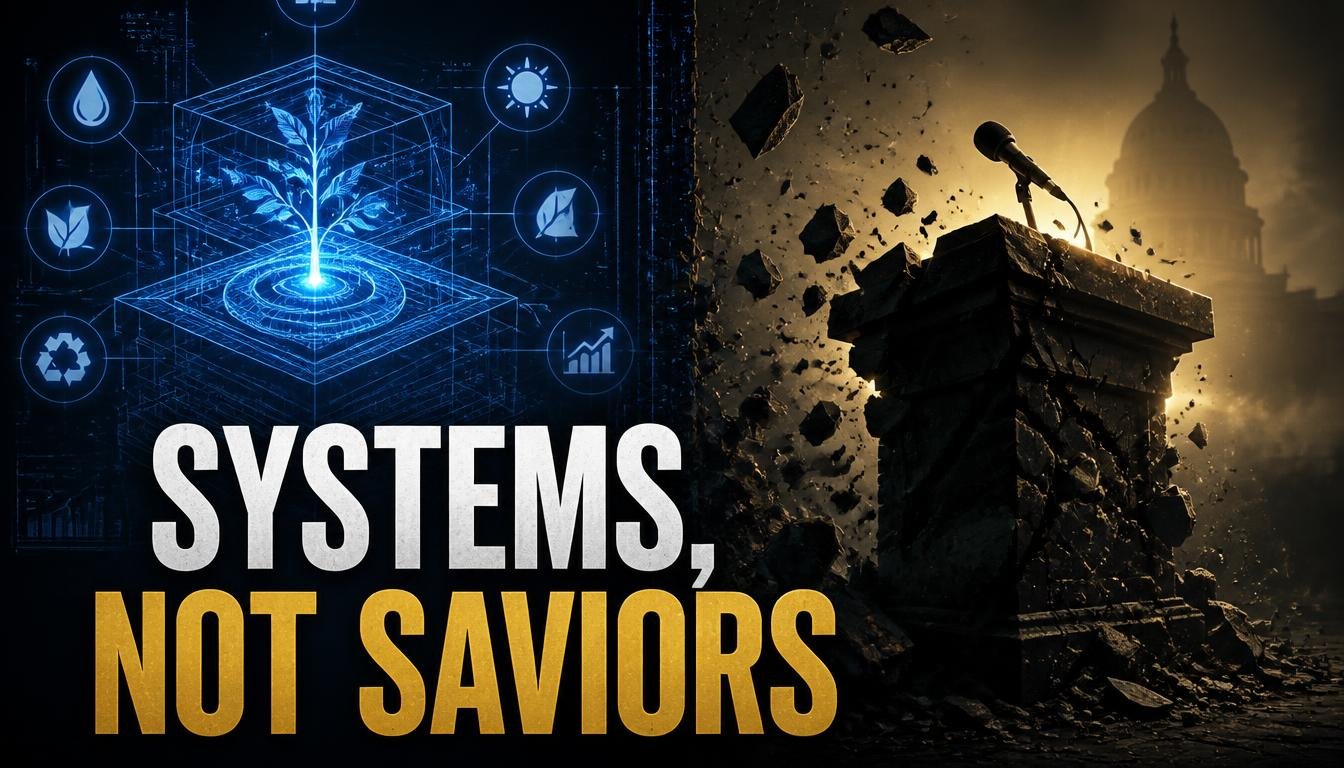
Poliarchism Explainer: Why Changing Leaders Never Fixes a Broken System
Have you ever asked yourself a simple yet devastating question after every election: Does changing a leader actually change a broken system? Every few years, societies place all their hopes on a single name on a ballot, utterly convinced that this new charismatic personality will finally fix everything. Yet, regardless of who wins, the same deep-seated corruption, inefficiency, and institutional decay remain intact. In this comprehensive Poliarchism Explainer, we dissect a ground-breaking political doctrine designed to break this vicious cycle once and for all.
Authored by political strategist and thinker Philips Ferdinand Saavedra, the groundbreaking doctrine presented in POLIARCHISM by Philips Ferdinand Saavedra demands that we stop obsessing over the people in charge and start focusing on the actual machinery they operate. A nation cannot outgrow the limitations of a broken system simply by changing the operators. This detailed Poliarchism Explainer breaks down the structural mechanics required to build a self-sustaining, resilient nation.
🔥 Ready to Master System-Centric Governance?
Discover the full blueprint for building a resilient polycratic state that outlasts corrupt politicians.
Get “POLIARCHISM” on Amazon Now1. The Personality Politics Problem Explained
To fully understand this Poliarchism Explainer, we must first address the root cause of democratic failure: the personality politics problem. Drawing from Volume One of the doctrine authored by Philips Ferdinand Saavedra, we see a critical diagnosis of global governance failure. Born from grassroots campaign observations and disaster recovery operations in the Philippines—where weak infrastructures fail rapidly—the doctrine reveals patterns present in democracies worldwide.
When societies become obsessed with who should lead instead of what system should govern, extreme fragility ensues. Public trust gets dumped into fallible individuals rather than enduring institutions. Consequently, elections degrade into popularity contests. With every transition of power, institutions get bent or dismantled to serve the new ruler’s ego, conditioning citizens into a state of passive dependency where they endlessly wait for a political savior.
2. Defining Polyarchism and the Polycratic Engine
What exactly is polyarchism? As highlighted in this Poliarchism Explainer, polyarchism is an overarching political philosophy that flatly rejects personality-driven politics. It demands a paradigm shift from how power is held to how power is formed, distributed, and sustained. It prioritizes structure, continuous citizen participation, and bottom-up legislation that reflects local realities rather than top-down mandates from a centralized capitol.
The Engine of Polyocracy
If polyarchism is the theoretical framework, polyocracy is the operational engine. A polycratic state is designed to function seamlessly regardless of who occupies the top office. In a polyocracy, structural accountability is embedded into the system itself, ensuring that national success is independent of individual leadership personalities.
Financial Citizenship: The Missing Pillar
Perhaps the most revolutionary aspect highlighted in our Poliarchism Explainer is the concept of Financial Citizenship. Under this doctrine, economic discipline is no longer viewed merely as a private personal goal—it is elevated to a fundamental civic obligation. A nation cannot remain politically stable if its population is financially vulnerable and easily bought with short-term government handouts or political favors.
3. The Three Core Forces of Polyarchism
According to the core text of our Poliarchism Explainer, a polycratic state relies on three completely interdependent forces. Removing even one force weakens the entire societal framework:
- Civic Responsibility: Transforms the citizen from a passive voter waiting to be saved into an active participant in daily governance. Your civic duty does not end at the ballot box.
- Financial Citizenship: Directs citizens to earn responsibly, save, build assets, and achieve personal financial independence. A financially secure citizen cannot be manipulated by political bribery.
- Decentralized Governance: Structurally distributes authority so that real on-the-ground community needs drive national policy, preventing power from pooling at the top.
📚 Essential Research & Reference Links
Explore foundational concepts in political theory, institutional economics, and governance architecture across trusted institutions:
High DA Authority Resources (External):
- Learn about Robert Dahl’s Polyarchy theory via Encyclopedia Britannica.
- Research institutional economics at Harvard University.
- Analyze global governance indicators with the World Bank.
- Study political systems and civic data on Wikipedia.
- Explore democratic development benchmarks at Stanford University.
- Examine United Nations governance frameworks on UN.org.
- Review public policy research from Oxford University.
- Investigate economic citizen empowerment via the IMF.
- Understand decentralization policy at MIT.
- Access political science journals on JSTOR.
Internal Website Resources:
- Official Portal: Poliarchism Master Hub
- Read our Melvyn CC Valenzuela Homepage
- Explore About Melvyn CC Valenzuela
- Discover Published Books Catalog
- Check out Executive Security Services
- Read the Strategic Real Talk Blog
- Learn about The Future You Formula
- View The Retention Edge Framework
- Explore Kaizen Security Operations
- Connect via Contact & Advisory Portal
4. Polyarchism vs. Conventional Democracy
How does the message of this Poliarchism Explainer differ from modern democracy? The distinction lies in the fundamental question each framework asks:
| Feature | Conventional Democracy | Polyarchism (Polyocracy) |
|---|---|---|
| Core Focus | Who should lead? (Personality-centric) | What system should govern? (System-centric) |
| Elections | Emotional popularity contests | Rational structural alignment checks |
| Citizen Role | Passive voters waiting for saviors | Active financial & civic contributors |
| Transition of Power | Disruptive changes & policy shifts | Seamless institutional continuity |
As clarified in our Poliarchism Explainer, polyarchism is not anti-democratic. It fully embraces representation and accountability while fixing the personality-dependent execution that weakens modern political systems.
5. The 5-Stage Roadmap to Building a Polycratic State
How do we transition from political chaos to institutional resilience? The book POLIARCHISM by Philips Ferdinand Saavedra outlines a practical five-stage transformation model detailed in this Poliarchism Explainer:
- Awareness & Education: Introducing the paradigm shift—teaching citizens that we need resilient systems, not political saviors.
- Cultural Shift: Citizens begin practicing individual financial citizenship and daily local civic involvement.
- Structural Pressure: Empowered local communities demand bottom-up legislative reform from current leadership.
- Institutional Integration: Embedding decentralized governance structures and automated accountability mechanisms into law.
- Polycratic State Formation: Achieving a self-sustaining society that functions smoothly independent of political personalities.
“The strength of the nation is not measured by its leaders, but by the resilience of its systems.” — Philips Ferdinand Saavedra
Conclusion: Become the Architect of Tomorrow
As we wrap up this comprehensive Poliarchism Explainer, the ultimate challenge rests with you. Will you remain dependent on the political personalities of today, or will you help build the resilient systems of tomorrow? We must stop acting as passive subjects waiting for political saviors and start acting as architects of a polycratic state.
Order Your Copy of “POLIARCHISM” Today!
Take control of your political and financial future. Dive deep into the complete doctrine by Philips Ferdinand Saavedra and join the system-centric revolution.
Buy On Amazon NowVisit the Official Poliarchism Hub at melvynccvalenzuela.com